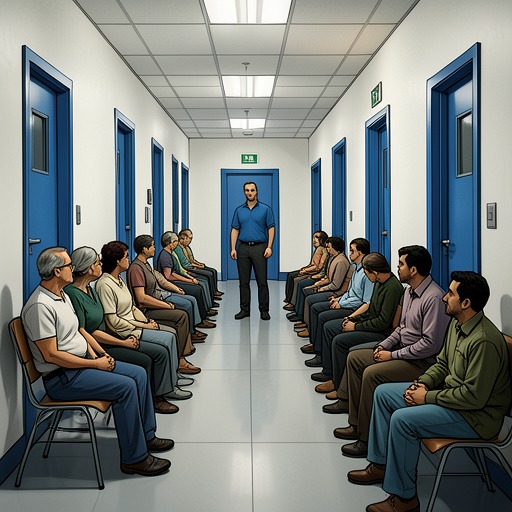
McMurphy secures a second day room
One Flew Over the Cuckoo's NestRandle Patrick McMurphy secures a second day room by turning a dispute about the ward’s radio into a workable proposal for sharing space. The unused tub room becomes the answer to a conflict between younger patients who want quiet and older patients who struggle to hear the radio; Dr. Spivey’s support and a temporary staffing plan carry the proposal past Nurse Ratched’s objection. The decision is a small but concrete shift in who can shape the ward’s daily arrangements: McMurphy supplies the idea, the doctor makes it administratively plausible, and the patients’ assent helps make it real.
The Problem Behind the Proposal
The plan addresses the ward’s mixed population of young and old patients. Dr. Spivey explains that the arrangement is not ideal for the Therapeutic Community, but the Geriatric Building is overloaded, leaving the groups together. The radio makes this shared space a practical problem: some older patients have difficulty hearing it, while younger men have complained that its volume interferes with conversation and reading.
McMurphy’s suggestion connects those competing needs rather than treating one group’s preference as the only one that matters. As Dr. Spivey later recounts, McMurphy first proposed turning up the speaker so the older men could hear. When the doctor pointed out that the radio was already too loud for some younger patients, McMurphy suggested giving readers somewhere quiet to go. The unused tub room, where tables are stored during ward meetings, offers a possible solution. Dr. Spivey notes that the room no longer serves its original hydrotherapy purpose because the hospital has new drugs, making its conversion seem practical rather than disruptive.
From Informal Suggestion to Staff Proposal
Before the group discussion, McMurphy approaches Nurse Ratched directly with the idea of opening the room for card players. He presents it as a benefit to both sides: the players could move into the otherwise unused space, while the older men could stay in the main day room with the radio. Nurse Ratched declines, saying there is not enough personnel to cover two day rooms. She also tells him not to lean against the glass because his hands are oily and would stain it, adding that someone else would have to do the extra work.
McMurphy jerks his hand away and starts to answer, but stops when he realizes that cursing is the only response she has left open to him. His face and neck redden. He takes a long breath, concentrates on his willpower, apologizes for bothering her, and returns to the card table. The exchange demonstrates that the obstacle is not simply finding a useful room: Nurse Ratched can close down the proposal by controlling the conversation and invoking the labor required to maintain the ward.
At the group meeting, McMurphy gives the proposal a different footing. Rather than pressing the request himself, he prompts Dr. Spivey to present the idea as something they developed together. The doctor explains the radio problem, the patients’ different needs, and the possibility of using the tub room as a second day room or game room. His account turns McMurphy’s initial suggestion into a plan addressed to the whole group, with the doctor’s authority behind it.
The Objection and the Trial Arrangement
Nurse Ratched praises McMurphy’s interest in the other patients, then repeats that there are not enough staff to cover another day room. She appears to regard the objection as decisive and begins to reopen her folio. Dr. Spivey, however, has considered the staffing problem. He reasons that the main day room will largely contain Chronic patients, many of whom are restricted to lounges or wheelchairs, and suggests that one aide and one nurse could remain there.
He then proposes that the other two aides and nurses cover the men in the tub room, perhaps more effectively than they can cover the larger existing space. Instead of asking the group to approve a permanent change, he recommends trying the arrangement for a few days and retaining the option to lock the room again if it does not work. The trial makes the decision reversible, directly answers Nurse Ratched’s staffing argument, and allows Dr. Spivey to present the change as a practical test rather than a challenge to ward authority.
The patients respond with nods and smiles. Cheswick, still standing apart from McMurphy, emphatically supports the doctor’s suggestion that the room can be locked again if the experiment fails. Dr. Spivey reads the group’s reaction as approval of his own idea; pleased by the response, he blushes and polishes his glasses before moving the meeting along. Chief Bromden observes his happiness, while Nurse Ratched’s hands appear to shake as she tries to return to the agenda.
Significance and Immediate Aftermath
The approval gives the patients a second place to gather and separates, at least in the plan, the competing uses of the day room. Its significance lies not in an established institutional reform but in the sequence that makes a limited change possible: McMurphy identifies a shared need, Dr. Spivey publicly adopts the solution, and the group’s visible agreement counters Nurse Ratched’s attempt to end discussion through the staffing objection. The proposed trial also leaves management an exit, so the victory is real but bounded.
The episode further complicates the ward’s hierarchy. Dr. Spivey does not merely endorse McMurphy in private; he presents the proposal to the group and supplies the operational argument Nurse Ratched had used to block it. McMurphy, meanwhile, does not win by forcing a confrontation in the meeting. He helps the doctor make the case, and the patients’ response completes it. The change therefore depends on both individual initiative and collective assent.
Once the room is agreed upon, Nurse Ratched tries to resume the meeting’s planned subject. McMurphy immediately stands, raises his hand, shifts from foot to foot, and redirects attention with a question about a dream. The transition suggests that the success has not ended the contest over who controls the meeting’s agenda; it has given McMurphy another opening to interrupt it. The second day room is a practical gain, but the scene also makes visible a broader change: the patients have watched a proposal survive an objection and receive the group’s support.